

First year university. Calculus with proofs.
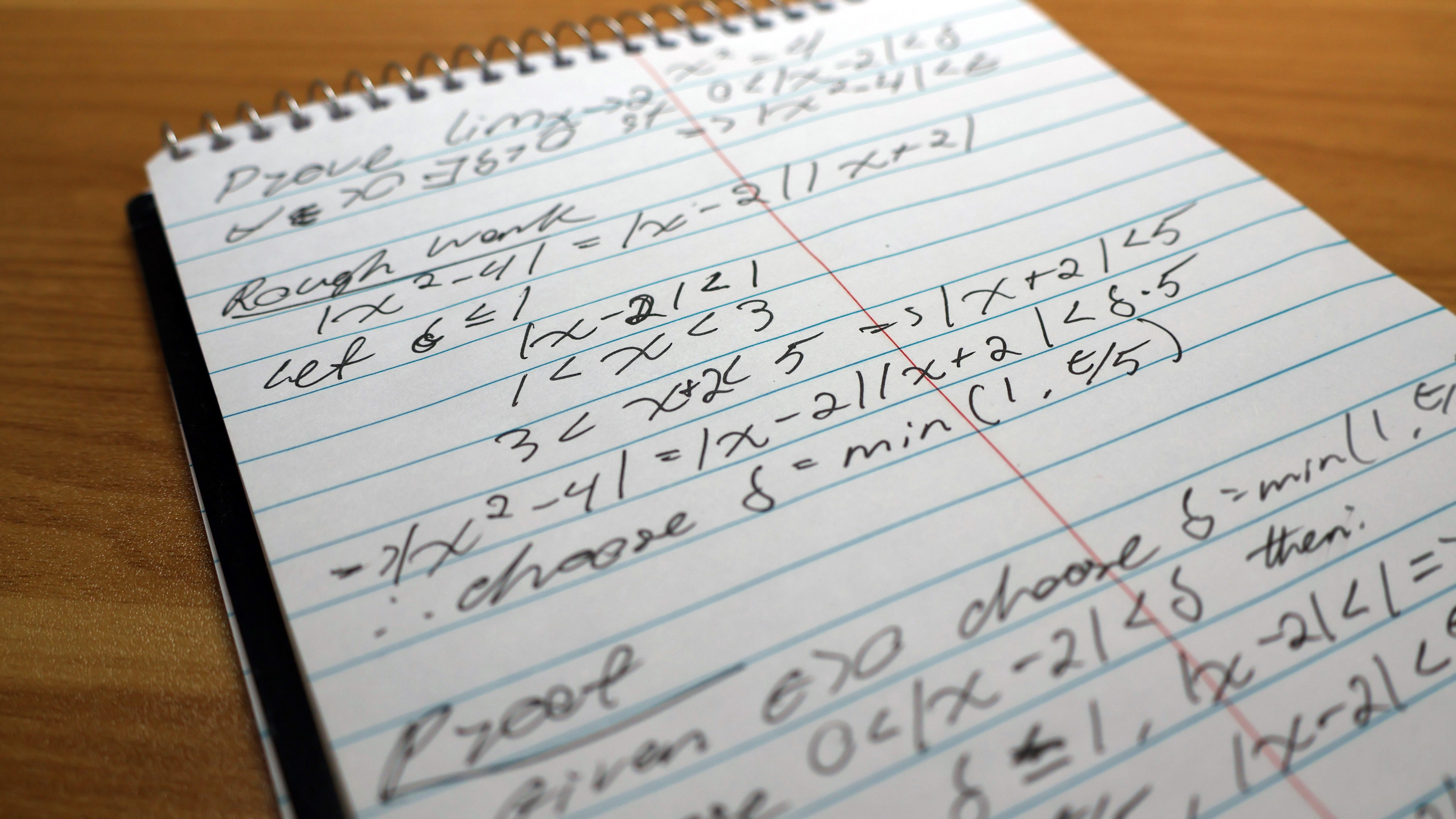
Specifically epsilon delta proofs. If you’ve done them, you know. If you haven’t: you’re given a limit and asked to prove, rigorously, that it exists. No formula. No method to reach for. You construct the argument from nothing, scouring for a path through the logic.
I’d graduated high school with 98% in advanced functions and 97% in calculus. I thought I was good at math.
I wasn’t.
I was good at stamping.
Every problem I’d ever solved had an instruction book. A known path someone else had already walked. You learn the method, apply the method, get the mark. University math didn’t work that way.
People started dropping. A couple months in, a student asked the prof something like: how do you even come up with this? The proof makes sense when you put it on the board, but sitting down and producing it from nothing? I can’t seem to do it.
“Think outside the box.”
I’d heard that phrase a hundred times. I never knew what I was supposed to do with it. This time the box was right there in front of me. I could see exactly what it was. And the proof didn’t fit inside it.
More people dropped. Then so many dropped they closed our lecture section entirely and merged us with another.
I spent more time on that course than my other four combined. It just didn’t click like the other courses did. It was hours. Days. Hundreds of abandoned proofs, multiple notebooks worth of scrap. And then, slowly, without a moment I could point to — I started solving them. Finding new angles nobody had shown me. Paths I’d built myself.
That was the first time I had ever felt that. I didn’t have a word for it then.
The word is creativity.
In middle school art class I’d sketch mountains and classmates would stop and look. My teacher was impressed. I was proud — because it felt like the eye and the hand were finally working together.
But I was stamping. I’d learned one peak. One way to draw a mountain. Stretch it, warp it, tilt it — at the core it was always the same piece. Same angle. Same mountain. Good at seeing. Not finding anything new.
I didn't know the difference yet. I thought creativity lived in art class — obviously.
It was novelty. And novelty is cheap — every bad idea is technically novel. Creativity is finding an angle on something that was already there, but one that nobody else was able to see.
Newton didn’t invent gravity. Gravity was there, dropping apples, moving planets, completely indifferent to whether anyone understood it. What Newton did was find a way of seeing it that nobody had managed before. The angle was new. The thing being seen was ancient.
Cantor didn’t invent infinity. Mathematicians had been tripping over it for centuries. What he did — the diagonal argument — was stand somewhere new and look at it differently. The proof that some infinities are larger than others. Same territory everyone else was working. Different angle.
That’s the whole game. That’s all it ever was.
Which means my middle school mountains weren’t creative. Not because they weren’t good. Because the angle was borrowed. I was seeing mountains the way mountains get seen. Nothing new was found.
People say AI isn’t creative because it’s just pattern matching. Just remixing what came before.
But go back and look at what Newton was doing. What Cantor was doing. They were working from the same inputs as everyone around them — same papers, same problems, same mathematical tradition. The insight wasn’t delivered from outside. It was latent in everything they’d read and thought and tried and failed at, until suddenly it wasn’t latent anymore.
The question was never about the inputs. It was always about the angle.
Go is a 3,000-year-old strategy game, simpler in rules than chess but so vast in possibility that mastering it was considered one of the hardest problems in AI. AlphaGo was Google DeepMind's attempt to crack it.
And in 2016, AlphaGo played Move 37 in Game 2 against Lee Sedol. Placed a stone where no professional would. Wrong position, wrong timing, wrong by every convention the game had built over centuries. The commentators went quiet. Then: “I think we’re seeing an original move here.”1
Centuries of Go. Millions of human games. We thought we’d mastered it. We thought every angle worth finding had been found.
That day, AlphaGo was creative.
Watch the commentators react to Move 37 in the AlphaGo documentary yourself.